
Why Multi-Generational Wealth Planning is Critical for Your Family’s Legacy
Multi-generational wealth planning is the strategic process of preserving, growing, and transferring wealth across generations while preparing heirs to be responsible stewards. Successful families focus on a blend of human and financial elements:
- Family Culture & Values: Establishing a clear mission and shared values.
- Heir Education: Teaching financial literacy and decision-making skills.
- Legal Structures: Using trusts and tax-efficient strategies to protect assets.
- Communication Systems: Creating formal meetings to prevent conflicts.
- Investment Philosophy: Maintaining a consistent, long-term perspective.
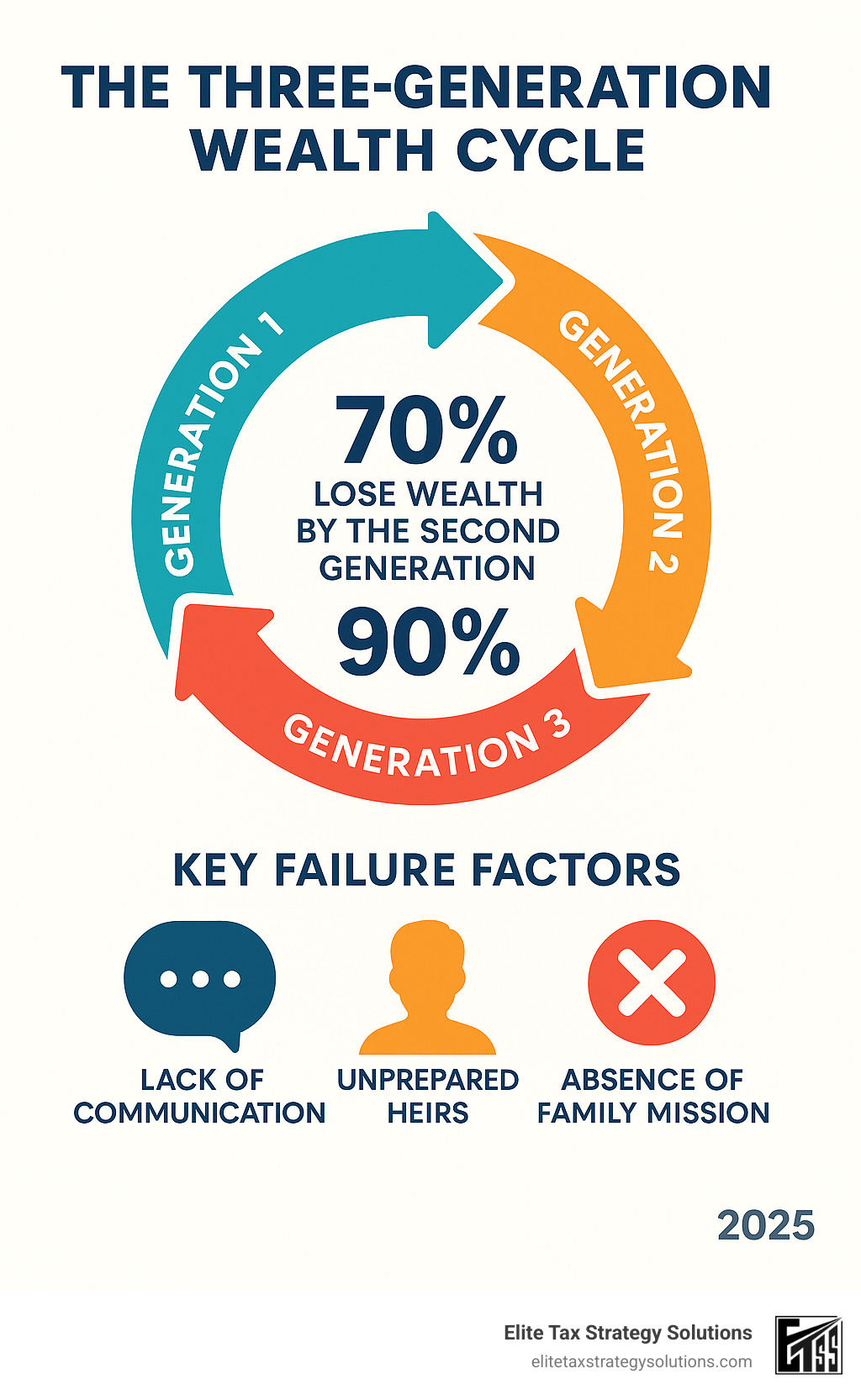
The numbers tell a sobering story. An estimated $84.5 trillion will transfer between generations over the next two decades. Yet history shows that preserving wealth is incredibly difficult, with a common saying that “wealth does not exceed three generations.”
Consider the Vanderbilt family. When Cornelius Vanderbilt died in 1877, he left an estate worth $100 million. Fewer than 50 years later, most of it was gone.
Successful families understand that proactive and intentional planning is critical. They focus on the human element—preparing, educating, and mentoring the next generation to be successful owners of wealth. My experience has shown that families who succeed long-term are those who balance sophisticated financial structures with strong family communication and values.
Essential multi-generational wealth planning terms:
The Foundation: Core Principles of Successful Multi-generational Wealth Planning

What truly determines whether your family’s wealth survives to the third generation? It’s the conversations around your dinner table. Families who beat the odds know that preserving wealth requires building something deeper than investment portfolios. They build a family culture and shared purpose that can weather any financial storm.
You can create the most sophisticated trust in the world, but if your heirs don’t understand why the wealth exists or how to manage it, it’s a ticking time bomb. At Elite Tax Strategy Solutions, we’ve seen that families who thrive are those who plan with their heirs, not just for them.
Defining Your Family’s ‘Why’: Vision, Mission, and Values
Every family legacy needs a North Star—a clear reason for building and preserving wealth. I always ask families: Why are we creating this wealth? What do we want to achieve with it? These questions are practical planning tools that guide every decision.
Family storytelling is incredibly powerful. Sharing stories of how wealth was created—the risks, the failures, the hard work—helps the next generation understand that the wealth represents something meaningful. This creates “wealth appreciation,” encouraging stewardship over entitlement.
Successful families often document their values and create a family mission statement. This living document guides financial and philanthropic decisions, creates unity, and provides a framework for resolving conflicts.
Preparing Heirs for Stewardship, Not Just Inheritance
A hard truth: giving someone money doesn’t automatically make them good with it. Lack of financial education is a primary reason generational wealth disappears. The goal is to raise financially literate, capable adults who can make smart decisions.
We encourage families to start this education early and make it practical. Let teenagers manage actual budgets. Have them work alongside family financial advisors. Some of the most effective parents I know require their children to do hands-on work with family assets, whether it’s maintaining rental properties or helping with charitable activities. These experiences create tangible connections to the family’s wealth.
Key areas for heirs to master include: basic budgeting and investing, strategic thinking, communication skills, sound decision-making, and engaging with the family’s philanthropic goals.
The Art of Family Communication and Navigating Generational Dynamics
If I had to pick the single most important factor in successful multi-generational wealth planning, it would be communication. Too many families keep the next generation in the dark about finances, which almost always backfires, leading to confusion and resentment.
Successful families accept transparency as a core value. They hold regular family meetings to discuss financial topics openly. These conversations build trust and ensure everyone understands the family’s goals.
Generational differences can be tremendous opportunities. Younger generations bring fresh ideas about technology, social values, or new investment approaches. The key is creating structured opportunities, like family meetings with clear agendas, for these different perspectives to be heard and valued. When families get communication right, wealth becomes a tool for bringing the family closer together.
Positive Effects of Family Planning in Financial Stability
The Blueprint: Financial and Legal Structures for Wealth Preservation

Think of multi-generational wealth planning like building a house. You need a foundation of family values, but you also need the right blueprints. Sophisticated financial and legal structures are the scaffolding that protects your family’s wealth from taxes, creditors, or economic downturns. Without the right legal structures, families can lose significant wealth. With proper planning, these tools can work powerfully in your favor.
How to Use Trusts and Legal Structures for Long-Term Protection
Trusts are smart ways to protect and control how your wealth is passed down. They are instruction manuals for your money that keep working when you’re not around.
- Family trusts act like protective shields around assets, keeping them safe from creditors or divorcing spouses. They ensure your wealth is managed according to your wishes.
- Testamentary trusts, created after you pass away, are helpful for heirs who aren’t ready to handle large sums. They can provide structured distributions for education, a home down payment, or full access at a later age.
- Irrevocable Life Insurance Trusts (ILITs) solve a major problem: paying estate taxes. An ILIT can hold a life insurance policy to provide tax-free cash to pay taxes, preventing a forced sale of a family business or real estate.
- Generation-Skipping Trusts (GSTs) allow wealth to pass directly to grandchildren, potentially skipping an entire generation’s worth of estate taxes and saving millions over time.
These structures aren’t just about saving money; they protect your family from making costly mistakes. Tax Efficient Estate Planning and Trust and Estate Taxes become much more manageable with the right foundation in place.
Mastering the Tax Landscape of Wealth Transfer
The tax landscape for wealth transfer is complex, but understanding it can save your family enormous amounts of money.
- Estate tax is a tax on your property when you die. There is a significant exemption, but it is scheduled to drop by roughly half on January 1, 2026, creating a narrow window of opportunity for planning.
- Gift tax applies to transfers made while you’re alive. You can use the annual exclusion ($18,000 per person in 2024) to transfer significant wealth over time without tax consequences.
- Inheritance tax is a separate tax some states levy on heirs.
- Capital gains tax affects the profit from selling assets. Roth conversions can be valuable here. By converting traditional retirement accounts to Roth accounts, you pay taxes now, allowing your heirs to inherit accounts they can withdraw from tax-free.
Successful families understand that tax planning is about paying taxes strategically. Our High Net Worth Tax Strategies help families steer these waters.
Aligning Your Investment Philosophy Across Generations
Many families forget to transfer the wisdom of how to manage assets. Your investment philosophy might be more valuable than the assets themselves.
Long-term thinking is the cornerstone of generational wealth. This means teaching the next generation to think in decades, not quarters. A mistake we see is fragmented investment management, where different family members manage their portions separately, leading to higher fees and uncoordinated risk.
Holistic portfolio management keeps everyone on the same page, providing better access to top managers, efficient fees, and coordinated decision-making. The goal is to pass down the knowledge and discipline that created the wealth in the first place.
Building a Framework for Success: Family Governance

If your plan is a house, family governance is the framework that holds it all together. Without proper governance, even the wealthiest families can fall apart. It creates the structure that keeps everyone working together, especially when disagreements arise.
The Benefits of a Family Council
A family council is essentially your family’s board of directors. It’s a way to ensure everyone has a voice in how your family’s wealth is managed. Key benefits include:
- Representation: It ensures each branch of the family tree is heard, preventing a few strong personalities from dominating decisions.
- Education: It serves as a classroom where younger members learn about money, investing, and responsibility.
- Conflict Prevention: It provides a forum for regular, open dialogue, addressing small issues before they become big problems.
- Cohesion: It keeps family branches connected to a shared mission and values, even as they grow and spread out.
Crafting a Family Constitution
A family constitution is a document that outlines what your family believes and how you want to handle your wealth together. It’s a roadmap for future generations.
Key elements to include are:
- Documented Values: What does money mean to your family? Is it about security, freedom, or helping others?
- Investment Guidelines: What is your family’s comfort with risk and what are your long-term goals?
- Roles and Responsibilities: Who makes decisions? How are new spouses included? What happens if someone leaves the family business?
- Philanthropic Mission: What causes does your family want to support together?
- Process for Amendments: How can the constitution be updated as the family evolves?
The process of creating a family constitution is often as valuable as the document itself. These deep conversations about values, money, and legacy bring families closer together and strengthen family bonds.
Strategic Execution: Key Strategies and Common Pitfalls

Now it’s time to execute. You’ve built the foundation and designed the blueprint, but multi-generational wealth planning isn’t complete until you implement your strategies effectively while avoiding common pitfalls. This phase is like playing chess—every move matters, and the stakes are your family’s legacy.
Strategies for Effective Multi-generational Wealth Planning
The most successful families follow certain key principles:
- Start with yourself first. Ensure your own financial security and retirement are rock-solid before planning for others.
- Time is your greatest ally. The earlier you begin, the more powerful your tools are. Starting early also provides more time to educate the next generation.
- Education is everything. Devote time and resources to teaching heirs about money. Involve them in real financial activities, like managing small budgets or attending meetings with advisors.
- Transparency builds trust. Share your family’s financial story and discuss distribution plans openly to prevent shock and resentment later.
- Use philanthropy as a teaching tool. Donor-advised funds are excellent for involving multiple generations in giving, teaching stewardship and aligning the family around shared values.
- Think holistically about investments. Managing assets together provides better access to top managers, fee efficiency, and a clearer view of your overall risk profile.
Common Pitfalls to Avoid in Multi-generational Wealth Planning
Even families with the best intentions can stumble. Avoid these common mistakes:
- Poor Communication: This is the number one killer of family wealth. When family members feel excluded or don’t understand the goals, resentment builds, leading to legal battles and fractured relationships.
- No Business Succession Plan: Only about a third of family businesses have a documented succession plan. Without one, a business can implode during an ownership change.
- Underestimating Taxes: Estate taxes, capital gains, and other transfer taxes can consume huge portions of wealth if not planned for strategically.
- Unprepared Heirs: Handing wealth to financially illiterate heirs is a recipe for disaster. Without proper education, even well-meaning heirs can quickly dissipate a fortune.
- The Liquidity Crunch: An estate might be worth millions on paper, but if there’s no cash to pay estate taxes, valuable assets like a family business or farm may have to be sold.
The Vanderbilt family story remains the ultimate cautionary tale of what happens when these pitfalls are not avoided.
The cautionary tale of the Vanderbilts
Ensuring Liquidity Without Selling Key Assets
How do you pay estate taxes without selling the family business or other irreplaceable assets? The solution is often life insurance.
Second-to-die life insurance pays out when the second spouse dies, which is exactly when estate taxes are typically due. This provides immediate cash when the family needs it most.
Crucially, this policy should be owned by an Irrevocable Life Insurance Trust (ILIT). When structured properly, the death benefit flows to the trust tax-free. The trust can then use the money to buy assets from the estate or loan it money to cover taxes, keeping valuable assets in the family.
For family businesses, buy-sell agreements funded by life insurance create a smooth ownership transition, providing funds for the business to buy out a deceased owner’s interest from their heirs.
Frequently Asked Questions about Multi-Generational Wealth Planning
Families beginning their multi-generational wealth planning journey often have similar questions. Addressing these common concerns early helps families make more informed decisions.
How early should a family start multi-generational wealth planning?
The honest answer? As soon as possible. The moment you have assets you want to protect or direct for a specific purpose beyond your lifetime, it’s time to begin planning. The earlier you start, the more tax-efficient strategies are available.
With the U.S. estate and gift tax exemption set to drop significantly in 2026, acting now can lead to substantial tax savings. More importantly, starting early gives you the time needed to properly prepare your heirs. Teaching financial stewardship takes years of conversations and hands-on experience.
What is the single biggest reason generational wealth fails to last?
Wealth rarely disappears due to market crashes alone. The real culprit is usually a toxic combination of poor communication and unprepared heirs.
Many families transfer millions to children who have never learned basic financial management. When heirs lack financial literacy, practical experience, or an understanding of the family’s values, they are set up to fail. Families that don’t communicate openly about wealth goals and expectations create a perfect storm for confusion, conflict, and poor decisions that erode the family’s financial foundation.
How do you balance fairness and equality when distributing wealth among heirs with different needs?
This is a core challenge for many families. The key is understanding the distinction: equality means giving everyone the same amount, while fairness means giving everyone what they need. These are not always the same.
Imagine one child is a successful professional while another has a disability that limits their earning potential. An equal distribution might not be fair. The most successful families approach this through open communication. They hold family meetings to discuss the reasoning behind their decisions. When children understand the ‘why,’ resentment often turns into understanding.
Your family constitution is invaluable here, as it aligns distribution decisions with documented family values. Custom legal structures like trusts can also help, providing different types of support based on individual needs. One trust might focus on education, while another supports a special needs heir.
Finally, consider lifetime gifting to help children when they need it most, and involve the whole family in philanthropy. Uniting around a shared charitable purpose can be incredibly bonding and puts individual inheritance differences in perspective.
Conclusion
Building a lasting family legacy requires a delicate balance between human elements and financial mechanics. Successful multi-generational wealth planning is not just about the numbers; it’s about creating something that endures.
The foundation begins with family culture and open communication. By defining your shared values and preparing heirs to be thoughtful stewards, you can break the cycle that has claimed so many family fortunes.
These strong relationships must be supported by sound financial and legal structures. Trusts, ILITs, and sophisticated tax strategies provide the scaffolding that protects your wealth from creditors, minimizes taxes, and ensures smooth transitions. Furthermore, family governance structures like councils and constitutions create a framework for fairness and decision-making that can prevent conflict across generations.
The stakes are high. With $84.5 trillion set to transfer between generations and a historical 90% failure rate by the third generation, a proactive strategy is essential. The Vanderbilt family’s story is a stark reminder that even the greatest fortunes can vanish without proper planning.
At Elite Tax Strategy Solutions, we understand that every family’s journey is unique. From our base in Jasper, Indiana, we help high earners and closely held businesses across suburban areas near major cities steer these complex waters. Our thorough, proactive approach to tax optimization forms the backbone of effective multi-generational wealth planning.
Your family’s story doesn’t have to end like the Vanderbilts’. With the right planning, communication, and professional guidance, you can create a legacy that not only survives but thrives for generations to come.
Take the next step with our comprehensive financial planning services